NASA Mars to Table Challenge · 2026

ESPERANZA II

Feeding fifteen people on Mars, for five hundred sols, without a resupply ship.

Everything a Mars crew eats today is packed on Earth and flown out. That does not scale to a permanent base, and it does not survive a missed launch window. ESPERANZA II grows 53% of the crew's calories on Mars — from the regolith outside the door — and it was designed from real NASA data rather than from assumptions.

15crew fed
500sols per rotation
53%calories grown in situ
0resupply flights

↓  Read the technical part (paper, Sept. 2026)

The trailer · 89 seconds

Not a finalist. ESPERANZA II continues.

In English, subtitled. Music: “Rising Tide” — Kevin MacLeod (incompetech.com), CC BY 4.0. Images: NASA/JPL-Caltech/ASU/MSSS and NASA/JPL-Caltech/MSSS.

In plain language

What this is, in two minutes.

The problem

Mars soil is not soil. It is a chemical hazard.

Three failures hit a Mars farm at once, and each one on its own is enough to end it. No prior food-system architecture resolves all three together.

01Perchlorate

0.4–0.6 wt% of the regolith at the Phoenix site is perchlorate — a thyroid-disrupting salt that is lethal to crops and has since been found at widely separated landing sites.

02Mineral sterility

The iron, calcium and magnesium are there, but under 5% is bioavailable at pH 7.8–8.5 with no organic ligands. A 100% Mars substrate yields no edible crop.

03Gut collapse

ISS, the MARS500 520-day analogue and the NASA Twins Study all show the same radiation-driven loss of short-chain fatty acids. No current food system treats it.

The system

Five modules, one loop.

Each module is parameterised and reconciled against the others: lighting, water, heat, carbon and crew time are treated as one physical system, not as five separate budgets.

LunaRex TRL 3
Machine-learned mineral mapping of lunar and Martian regolith — random forest plus Gaussian process, 77% classification accuracy — to find which material is worth processing at all.
MarsRem TRL 4
Bacterial perchlorate removal using Azospira suillum, driving residual perchlorate below 0.017 wt% by Sol 24 and holding it there as a monitored food-safety control point.
HybridSoil TRL 4
The counter-intuitive one. Lunar highland regolith is flown as radiation shielding on the way out, then repurposed as the calcium and magnesium corrector that Martian regolith lacks. The shielding becomes the fertiliser.
CyanoGrow TRL 5
Arthrospira and Anabaena in a photobioreactor, fixing nitrogen straight out of the thin Martian atmosphere at 100 hPa.
FermentLab TRL 5
Miso, tempeh, kefir, bread and Tenebrio molitor — real animal protein — turning inedible stems, roots and husks back into food. Nothing agricultural leaves the loop.
NEXUS TRL 3–4
The control layer that makes two specialists enough to run a farm that would otherwise need six to eight operators.

What is new

Four unusual design decisions.

  1. Lunar regolith as a targeted mineral corrector.

    47 verified Apollo and LRO samples against 35 Mars samples reveal a precise geochemical complementarity. A blend of 32.1% lunar and 21.3% Martian material reaches 4.2% iron and 5.8% calcium bioavailability, against under 0.5% for Martian regolith alone.

  2. A genetic algorithm that evolves the crew's probiotics.

    Four thousand candidate formulations, evolved across five fitness functions — radiation shielding, cosmic-ray repair, gut barrier, mood and immunity — trained on 400 ISS microbiome records.

  3. Every meal as radiation medicine.

    Space food has never carried living functional bioactives. Here the fermentation step doses radiation-protective metabolites continuously through 78 distinct meals, rather than through a supplement pill.

  4. A biometric loop that closes inside a single sol.

    A non-invasive wristband drives a metabolic model of the gut; the forecast re-optimises tomorrow's menu. Demonstrated, not asserted — on NASA's public Inspiration4 flight archive, multi-modal fusion separated pre- from post-flight state at 0.708 accuracy against a 0.489 null (p = 0.026), while no single biomarker survived correction.

The evidence

Real data, and the limits stated out loud.

Three verified NASA datasets ground every result, with no simulants standing in for measurements: 35 Mars regolith samples across seven missions from the Planetary Data System, 47 lunar samples from six Apollo missions and LRO, and 400 microbiome records from the Astronaut Microbiome Project, the Twins Study and MARS500.

A 74-publication review finds no prior system integrating lunar and Martian ISRU, perchlorate bioremediation, evolved probiotics, radiation-medicine fermentation and a closed biometric loop for a 500-sol crewed mission. Solution Summary §6

Where the work is immature, it says so. LunaRex sits at TRL 3 with no sorting hardware built. The biometric inference rests on four subjects in low Earth orbit and is published as a preprint under review. Those are stated as gaps to close, not smoothed over — a reviewer should be able to judge the development path rather than infer it.

By the numbers

The budgets that have to close.

Crew fed, per rotation15 people · 500 sols
Daily caloric requirement3,035 kcal/crew/sol
Grown on Mars24,141 kcal/sol · 53.0%
Flown from Earth (cap is 50%)47.0% by calories
Distinct meals in rotation78 across 14 sols
Meals as radiation medicine78 meals dosing functional bioactives
Probiotic formulations evolved4,000 candidates × 5 fitness functions
Growing area511 m² in 1,058 m³
Food-system power58.1 kW mean · 64.0 peak
Water recovered98.5%
Oxygen returned to the habitat116% of crew demand
Specialist labour (the one hard limit)79.5–81.2 of 90 h per 5 sols
Sustained horizon4+ rotations · ≈5.6 Earth years

Mass, power, volume and water are unconstrained in this challenge. Crew time is the one resource the rules constrain with the word must — and it is the budget that decides whether any of the rest is real. Every hour above is recomputed from the meal plan itself, ingredient operation by ingredient operation, with a public script.

The technical part · paper, September 2026

Crew time as the binding constraint.

Crew time as the binding constraint of a bioregenerative food system for a fifteen-person, 500-sol Mars surface mission: design reconciliation and a 14-sol meal plan — M. J. Puerta Angulo, 2026. Preprint and data package (meal-plan workbooks, scripts, design documents) in open deposit on Zenodo, DOI 10.5281/zenodo.22713680. What follows is a technical summary of the paper.

📄  Download the full paper (preprint v1 · PDF · 18 pages)  Open data & scripts (GitHub, v1.0)  Preprint page (citation and abstract)

1 · Method: every budget closes against its neighbours

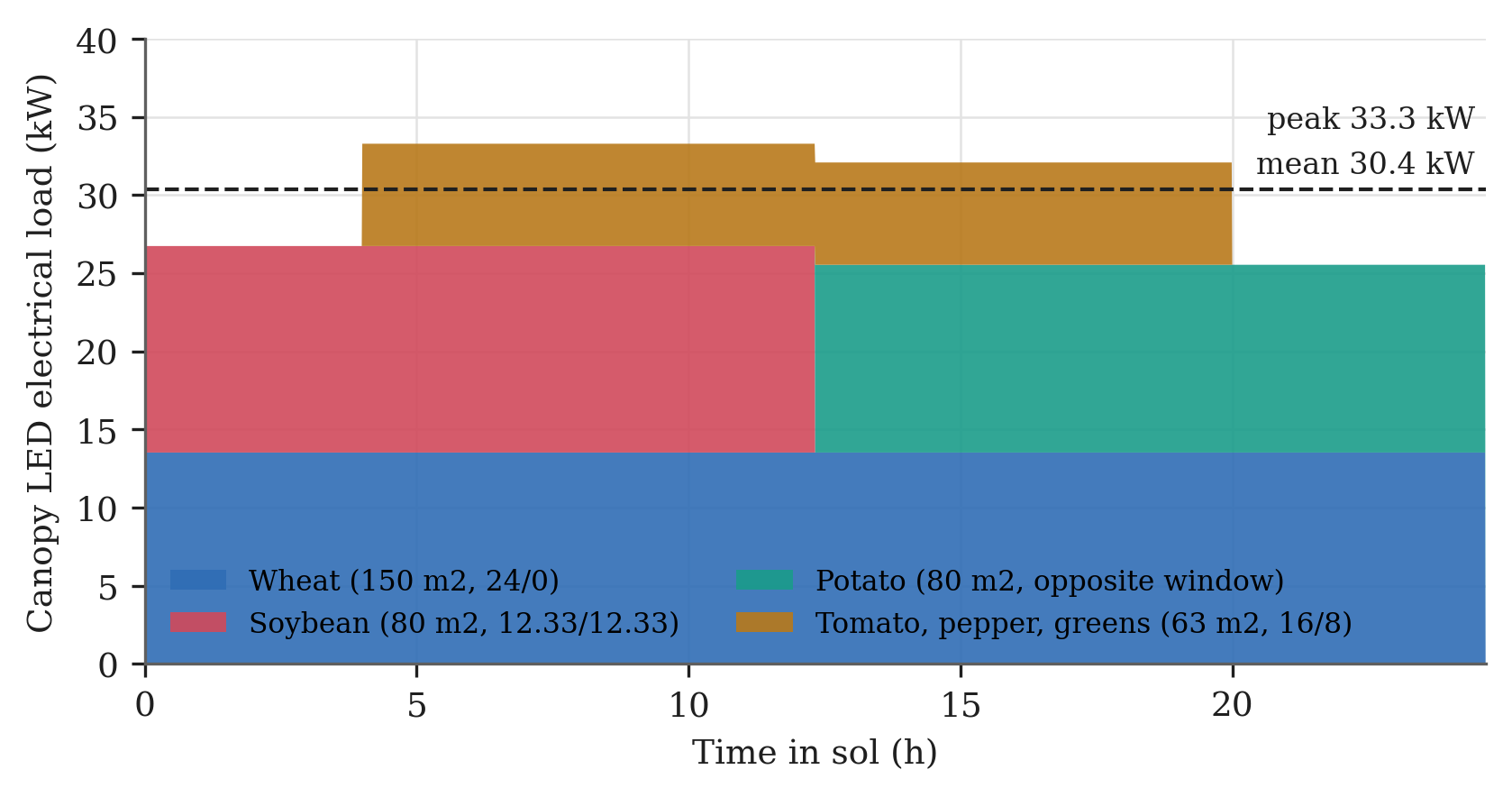
The lighting power that sets the electrical budget is the same energy that evaporates the canopy's water and that the radiator has to reject; the ingredient list that sets the Earth-food fraction is the same list that sets the galley hours. Transpiration is derived from absorbed light, E = PLED·fabs·flat·tsol / Lv = 644 L per sol; an earlier revision carried 3,226 L per sol, which would need 89 kW of latent heat against 30.4 kW of lighting. That coupling is what caught the error.

2 · Lighting: photoperiod tessellation flattens the peak
Canopy LED electrical load over one sol by crop zone
Canopy LED load over one sol (24.66 h). USU-Apogee wheat runs continuously as baseload; soybean and potato occupy opposite 12.33-h windows; leafy and fruiting crops run 16/8. Mean 30.4 kW, peak 33.3 kW: only 9 % above the mean, with no large battery.

3 · Hours: recomputed from the 1,004 lines of the meal plan
Galley labour per sol and per rolling five-sol window
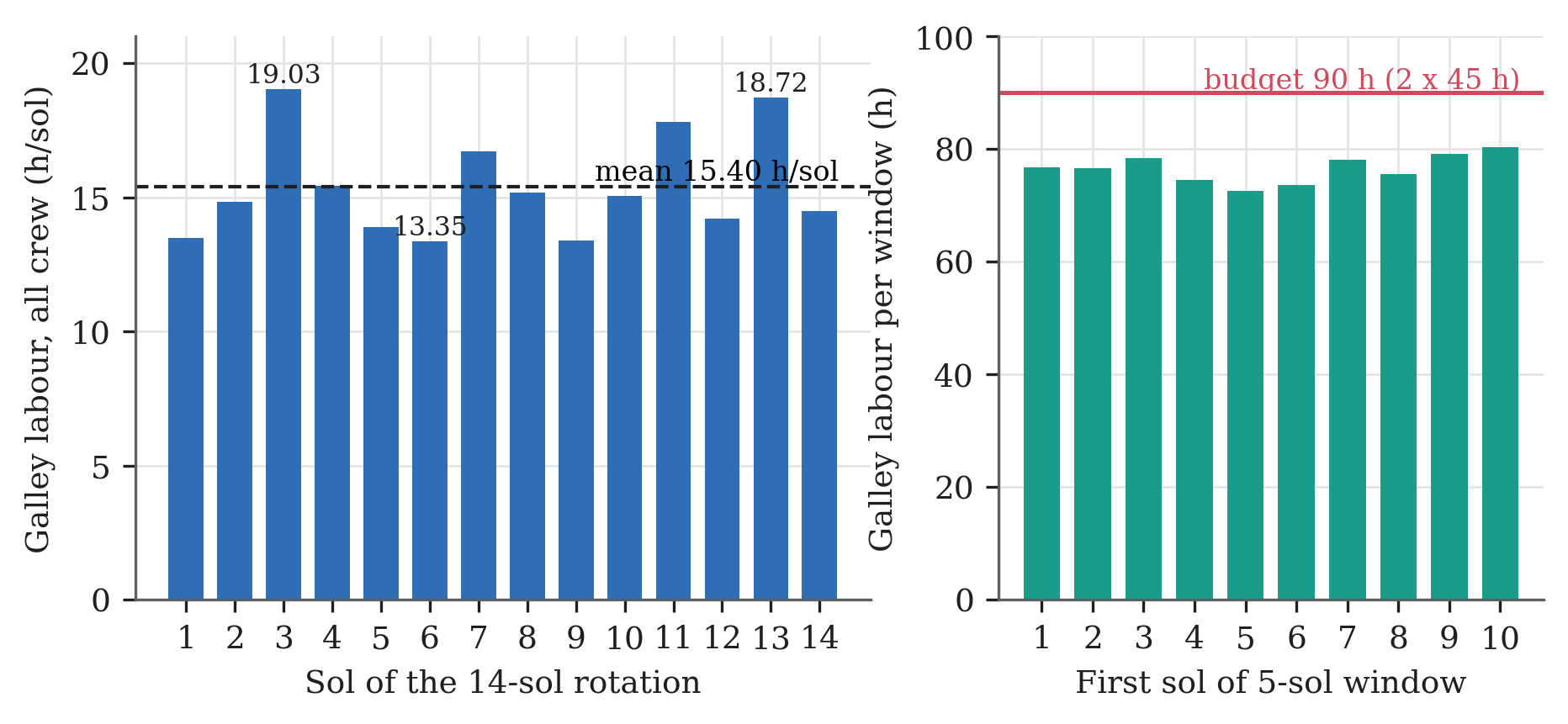
Left: whole-crew galley hours per sol (mean 15.40 h; peak 19.03 h on sol 3; minimum 13.35 h on sol 6). Right: each of the ten rolling five-sol windows against the two specialists' 90-h budget; the worst totals 80.3 h before partition between specialists and the cooking rotation.

Accounting per ingredient event (preparation once per ingredient per sol, cooking once per ingredient per meal, cleaning once per ingredient per sol): the unbatched line-by-line sum would be 21.03 h per sol, 37 % more. Classifying each line by its production method, in-situ processing (fermentation, insects, mushrooms, soy, photobioreactor) adds up to 23.8 h per five-sol cycle and the other thirteen crew absorb about 45 minutes per person per sol in the cooking rotation. With 49.0 h per cycle of non-galley duties (cultivation, HACCP, maintenance, documentation), the two specialists land at 79.5 h in the worst window on the recomputation and 81.2 h on the design allocation, which additionally assigns grain milling to them. Without the cooking rotation they would need 126 h.

4 · Earth-provisioned food: two declared bases, and the EVA supplement
Earth-provisioned share per sol and versus EVA hours
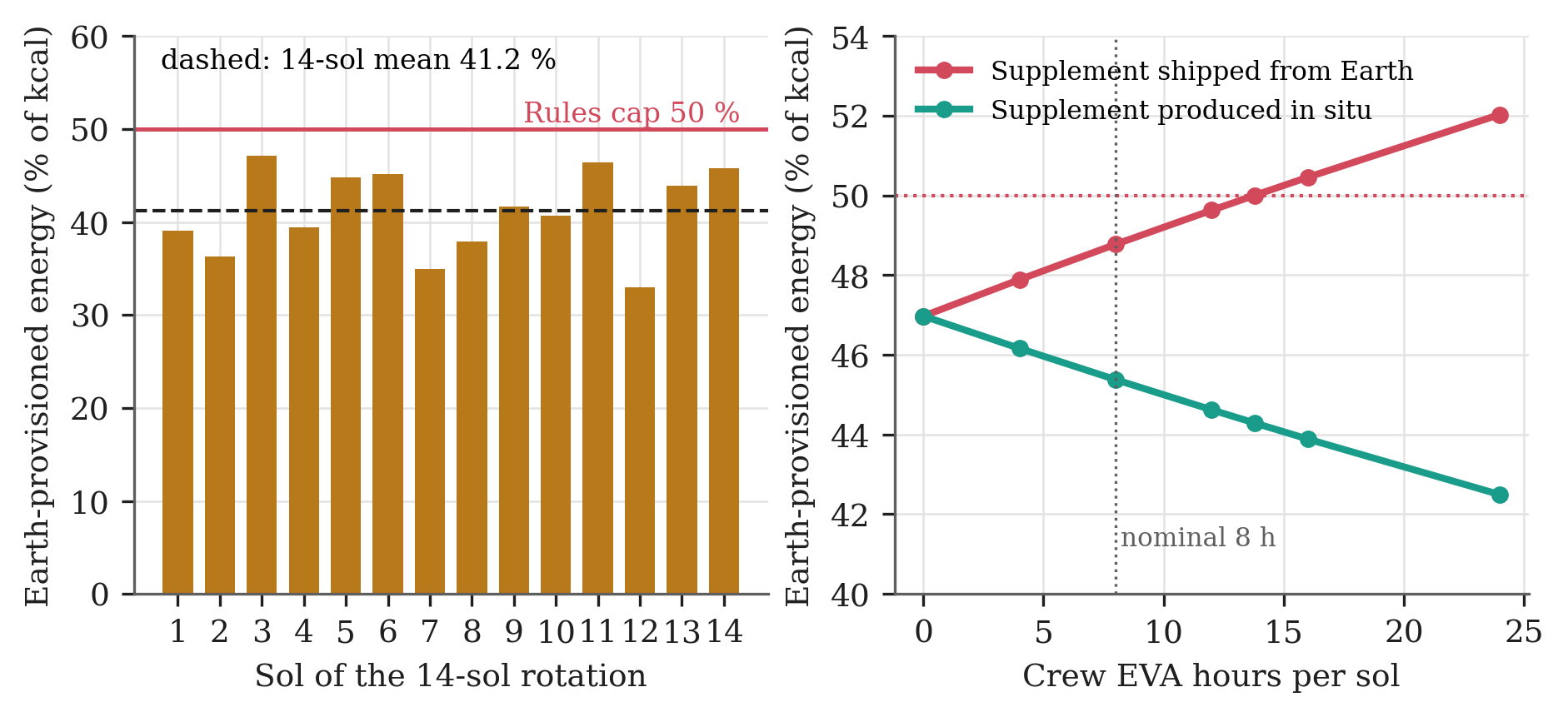
Left: Earth-provisioned share of calories on each sol of the rotation, audited ingredient by ingredient with USDA FoodData Central energy densities (mean 41.2 %; range 33.0–47.1 %; rules cap 50 %). Right: the same fraction on the crop-nameplate basis (47.0 %) against crew EVA hours: shipped from Earth, the 200 kcal per EVA-hour supplement breaches the cap at 13.8 h per sol; produced in situ, the fraction falls with EVA hours.

5 · The ledgers, in one table

Food-system electrical power58.1 kW mean · 64.0 peak · 77 installed
Of which canopy LED (373 m², 3.0 µmol/J)30.4 kW mean · 33.3 peak
Canopy transpiration / recovered / make-up644 / 634 / 9.7 L·sol⁻¹
CO₂ fixed (crops + spirulina) vs respired20.7 vs 15.4 kg per sol; 2.5 from the Martian atmosphere
O₂ released vs demand15.02 / 12.95 kg·sol⁻¹ · 116 %
Heat to reject · radiator (dusty case, α≈0.55)56.4 kW · ~300 m² at 40 °C
Fresh production nameplate24,141 kcal per sol (wheat 25 %, spirulina 24 %, Tenebrio 23 %, potato 11 %)
Energy delivered by the rotation3,059.9 kcal per person per sol (target 3,035) · protein 123 g · fibre 58 g · sodium 1,853 mg
Food-system launch mass25,729 kg, of which 6,274 kg Earth food per rotation
Technology readinessTRL 3 (regolith classifier) to 6–7 (LED, fermentation)

6 · Limitations, as stated in the paper

  1. No dynamic growth simulation: yields come from the NASA BVAD crop table and have not been confirmed at 56.5 kPa.
  2. Per-ingredient durations are engineering estimates, not measured in an analogue galley; the 49.0 h of non-galley duties are design allocations.
  3. One third of ingredient labels are low-confidence in energy density (6.4 % of calories); Tenebrio flour (5.2 kcal/g) has no USDA entry.
  4. Iron in the rotation (20 mg per sol) exceeds the 8–10 mg spaceflight ceiling: an open non-conformance, with the correction proposed but not applied.
  5. Three elements at TRL 3–4; the operations layer has not closed the loop to meal actuation with people.
  6. No cost analysis or launch manifest; a challenge design not reviewed by an independent engineering board.

Related work by the author: Bayesian multi-modal inference on NASA's public Inspiration4 archive (n = 4), preprint DOI 10.21203/rs.3.rs-10232328/v1, code and data on GitHub.

Mission math

22.76Mkcal per rotation
78unique meals — zero repetition in 14 sols
1,004ingredient rows audited
19peer-reviewed sources behind the video evidence

Back on Earth

None of this only works on Mars.

Perchlorate contaminates drinking water in arid regions where more than 500 million people live; the same bacterial process that cleans Martian regolith cleans that. The evolved probiotics target inflammatory bowel disease, which affects around ten million patients. The nitrogen-fixing cyanobacteria rebuild depleted farmland. All five pillars are dual-use by design, not by afterthought.

Background: Gale Crater rim, Mars — Curiosity rover · NASA/JPL-Caltech/MSSS

Who built it

One person, competing alone.

María Jesús Puerta Angulo

María Jesús Puerta Angulo

Mining engineer · Tarragona, Spain

A mining engineer who spent a career working out how to get useful material out of difficult ground, and then pointed that at the hardest ground there is.

International winner of NASA's LunaRecycle Challenge 2025 (Phase 1, Digital Twin category, among more than 1,200 teams from 80 countries) with ESPERANZA I, a system to turn lunar regolith and mission waste into resources. With ESPERANZA II she tries again on Mars: the same method, applied to Martian regolith and to the crew's table.

ESPERANZA II is a solo entry. Every concept, algorithm and model in it is her own work, and the whole architecture — regolith processing, bioremediation, the substrate optimiser, the control loop — comes from one desk.

Her personal site → mariajesuspuertaangulo.com

Connect

Talk to the person behind the loop.